
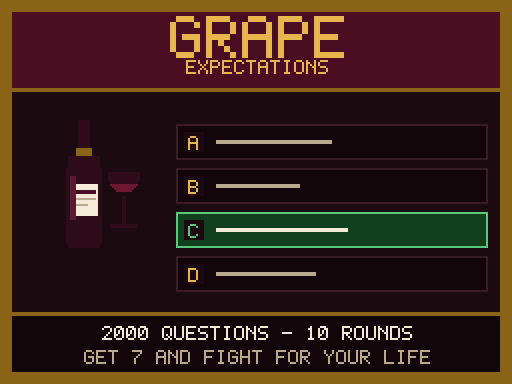
Grape Expectations
A new game, written for this site and released on 24 September 2026. Gassoft is the made-up software house behind it, and 1996 is the year it is pretending to be from.
▶ PLAY GAME▶ GUIDE: GRAPE EXPECTATIONS STUDY GUIDE: GRAPE SYNONYMS, SWEET WINES AND BOTTLE SIZES
Two thousand multiple-choice questions on wine, and ten rounds of ten standing between you and the cellar door.
Grapes and where they came from. Appellations, and which of them is allowed to grow what. Tasting notes, and the wine they belong to. Dessert wines and the four quite different ways a wine is made sweet. Sherry, Port and Madeira. Bottle sizes from the half to the Nebuchadnezzar. Food pairings. Winemaking methods, from bâtonnage to whatever a qvevri is. The producers, the critics, and the monk who did not invent Champagne.
Round one is the easy stuff — what colour Chardonnay is, which country Rioja comes from, what a sommelier does. By round ten you are naming the region a producer sits in and the grape behind a wine you have probably never been offered. Every round is drawn from a harder band than the last, and the rounds are gated:
- Six or fewer and your night ends there.
- Seven or eight buys you one hard question, pulled from two bands higher. Get it and you go on. Miss it and you are out.
- Nine or ten and you walk straight through, with a bonus for the trouble.
Nothing repeats inside a single game, so a full run is a hundred distinct questions out of two thousand, and a good player will be well into the second bottle before they see one twice.
When it ends you can put your name to the score, and it goes into the cellar book — a shared top twenty that everyone who plays sees, shown to you straight away with your own place in it. The cellar book has its own tab on the opening screen, so you can see who you are up against before you start. Your own device keeps a private record too, which is what you get if the shared board cannot be reached.
Scores are added up again on the server from the round-by-round record, so a run has to be one that could actually have happened. It is not cheat-proof — the quiz runs in your browser, and a determined person can post a run they never played — but nothing can claim more than a perfect 57,500.
SCORING
Every right answer is worth a hundred points times the round number. Round one answers are worth 100, and round ten answers are worth 1,000, because they are that much harder. Getting through a round with nine or ten right earns a further 250. A sudden-death question is worth a flat 500 if you get it right. It’s a gate, though, not an eleventh question, so it doesn’t count toward the round’s tally.
A TASTE OF THE QUESTIONS
From round one:
Which of these is a wine region of Australia? Barossa Valley, Rioja, Chianti or Burgundy.
From round four:
Which grape is classically described as “orange blossom, grape”? Chenin Blanc, Muscat Blanc à Petits Grains, Grüner Veltliner or Sémillon.
From round seven:
Which country is Verdelho originally from? Chile, New Zealand, Egypt or Portugal.
And from round ten:
Which grape is classically described as “lemon, bitter almond”? Sercial, Catarratto, Colombard or Verdicchio.
(Barossa Valley; Muscat; Portugal - it’s the grape of Madeira; Verdicchio.)
WHY THE NAMES THAT SOUND ALIKE GET EXPLAINED
Wine is full of names that are easy to get the wrong way round. Muscat and Muscadet. Verdelho, Verdejo and Verdicchio. Rutherford and Rutherglen. The two Montepulcianos, one a grape and one a town. On every question about one of these, the game tells you which is which after you answer, whether you got it right or not. If you’ve had them the wrong way round for years, you’ll find out why, rather than just being marked wrong.
HOW THE DIFFICULTY WORKS
Nobody sat and decided by hand how hard each question was. Every question in the bank is scored on four things:
- How famous the subject is. Barolo is easier to be asked about than Sagrantino di Montefalco.
- How hard the question is to answer. Naming a country is easier than naming a sub-region.
- How obscure the wrong answers are. “Which grape is Sauternes made from?” is easy if the other options are Chardonnay and Merlot, and hard if they’re Friulano and Roussanne. It’s the same question, so easy questions get household names as the wrong answers.
- Whether the answer itself is a surprise. Zinfandel is a household name, but the fact that it comes from Croatia is not.
The two thousand questions are then put in order of difficulty and cut into ten bands of two hundred. Round one draws from the easiest band and round ten from the hardest. The wrong answers are always genuinely wrong. The quiz knows the other names a grape goes by, the other wines that would suit the same dish, and the other regions that grow the same variety, and it never offers one of those as a wrong answer.
TIPS
- Read every option before answering. In the later rounds, two answers are often from the same country or the same colour, and the difference is in the detail.
- Learn from the notes. The explanation after an answer is often the answer to a question you’ll meet two rounds later.
- Grapes travel under other names. Shiraz and Syrah, Garnacha and Grenache, Primitivo and Zinfandel. If an answer looks unfamiliar, it may be a grape you know under another name.
- Sudden death is two bands harder. If you finish a round on seven or eight, the question you get comes from two rounds further on. Nine is a much safer place to be.
CONTROLS
| 1-4 or A-D | Pick an answer |
|---|---|
| Tap | Pick an answer, on a phone |
| Enter or Space | Carry on to the next question or round |
Original work
GEAR & BOOKS
SOME LINKS ARE AFFILIATE LINKS. WE MAY EARN A COMMISSION AT NO EXTRA COST TO YOU.