
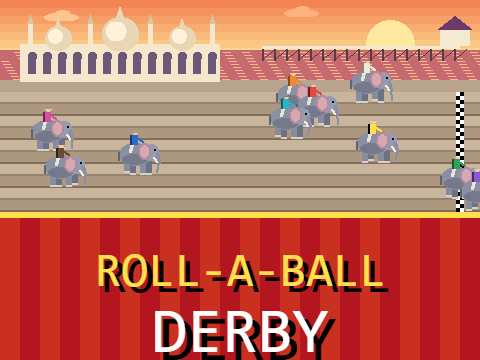
Roll-a-Ball Derby
A new game, written for this site and released on 1 November 2026. Gassoft Amusements is the made-up software house behind it, and 1985 is the year it is pretending to be from.
▶ PLAY GAME▶ GUIDE: ROLL-A-BALL DERBY GUIDE: HOW HARD TO ROLL AND HOW TO WIN THE FINAL
Everyone who has been to the seaside knows this one. You lean over a sloping table, roll a ball at a row of numbered holes, and somewhere above your head a little model horse lurches forward. Here it’s ten races at ten British resorts, and the horses have been replaced by whatever was available.
Roll your balls up the table and into the holes. Whatever you score moves your animal along the track, while nine rivals do the same. The first to 50 points ends the race, and everyone else is placed by how far they had got.
HOW TO PLAY
You have four balls, and you can have all of them on the table at once. Be careful, though: balls knock into each other, and a good shot can be ruined by your own last one.
On a computer, move the mouse to line up your ball, then hold the button to build power. Drag to aim, and let go to roll. On a phone or tablet, touch the screen where you want the ball and pull back like a slingshot. The line shows where it will go and the bar shows the power, so you can adjust before you let go. Slide back to where you started to cancel. Holes are more forgiving on a touch screen, since a finger can’t be as exact as a mouse, especially the blue and red ones and for a ball coming back off the far wall.
The table slopes back towards you, so power is everything. Too soft and the ball won’t even reach the first holes. Too hard and it hits the back of the frame and comes back at you, though it might drop into something on the way. Anything that misses rolls back down to your hand.
THE HOLES
- Yellow holes are worth 1. They’re big and forgiving.
- Blue holes are worth 2. They’re smaller, and the ball has to be going slower to drop.
- Red holes are worth 5. They’re the smallest, they’re always near the middle, and the ball has to be almost spent when it arrives. Later tables guard them with pegs.
You can’t keep going for the same hole. A lid shuts over any hole as soon as you score in it, and a ball just rolls over a shut hole. The wait for it to reopen gets longer as the tour goes on:
- Rounds 1 to 3: until you score in another hole.
- Rounds 4 to 6: until you sink two more balls.
- Round 7 onwards: until you score five more points.
Every level has a different arrangement. Yellow holes get scarcer from round 3, and from round 7 the tables have fewer holes altogether.
THE TOUR
Finish in the top three to go through, in the top two for the quarter-final and semi-final, and win the final to be crowned champion.
- Skegness, on donkeys: the Clock Tower, deckchairs and sand.
- Llandudno, on goats: the Victorian pier, under the Great Orme.
- Windermere, on Herdwick sheep: misty fells and a lake steamer.
- Isle of Wight, on red squirrels: the Needles and the coloured sands of Alum Bay.
- St Ives, on seals: a turquoise harbour and stone cottages.
- Aviemore, on reindeer: the snowy Cairngorms at dusk.
- Whitby, on Highland cows: the abbey by moonlight, above a stormy sea.
- Great Yarmouth, on ostriches: the quarter-final, among the neon arcades.
- Blackpool, on camels: the semi-final, under the Tower and the Illuminations.
- Brighton, on elephants: the final, at sunset by the Royal Pavilion.
SCORING
Your score is every point you roll across the whole run, plus a place bonus for each race: 20 for first, 10 for second and 5 for third. Ten straight wins makes 700, the most anyone can score. When your run ends, win or lose, you can put your name on the shared top twenty.
TIPS
- Rack up ones early. Going only for fives is a good way to lose to Nan.
- Plan your next hole. A ball already on its way to a hole you’ve just shut is wasted, unless it finds another one on the way back.
- Use a five to clear the table. From round 7, a single five reopens every other shut hole.
- Learn the weight first. Your aim matters less than how hard you roll.
- Leave a gap between balls. A ball coming back down will knock the next one going up.
- Use the back wall. A hard roll loses speed when it hits the back, and it can drop into a hole on its way home.
BEHIND THE GAME
Roll-a-Ball Derby is based on the real fairground machines, with their stepped green tracks and painted backdrops. It’s dressed as a seaside stall rather than a home computer, so it doesn’t use the Spectrum’s colours.
The balls are properly simulated. Each one is pulled back down the slope, slowed by the baize and bounced off the walls and pegs. Two balls that meet swap their momentum along the line between them, as real ones do. A hole only takes a ball that’s going slowly enough. A faster ball rides over the lip and gets tugged off its line, which is where the lucky bounces come from.
As with everything on this site, none of it is loaded from an image or a sound file. Each mural is painted by the game when the level starts, along with all ten animals and their riders. The organ music is synthesised in your browser from square waves.
CONTROLS
| Mouse | Move to line up your ball. Hold the button for power, drag to aim, and let go to roll. |
|---|---|
| Touch | On a phone or tablet, touch where you want the ball and pull back. Pull further for a harder roll, and let go to roll. |
| Arrows / A D | Move the ball along the rolling line |
| Z / X | Angle the roll left or right |
| Space | Hold for power and release to roll. Also starts the game. |
| P | Pause |
| M | Toggle music |
Original work
MORE LIKE THIS
GEAR & BOOKS
SOME LINKS ARE AFFILIATE LINKS. WE MAY EARN A COMMISSION AT NO EXTRA COST TO YOU.