
Roll-a-Ball Derby guide: how hard to roll and how to win the final
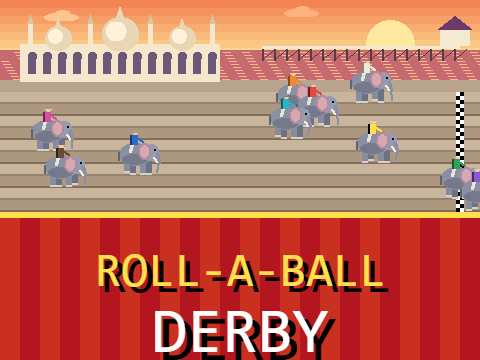
Roll-a-Ball Derby looks like a game of aim, but it’s really a game of weight. Every hole only takes a ball that’s going slowly enough, and the small ones are fussy about it. This guide works through the numbers in the game: how long to hold for each part of the table, how much room for error each hole gives you, and how quickly the other nine riders score in every race of the tour.
HOW TO PLAY
You have four balls, and you can have all of them rolling at once. Sink one and your animal moves along the track by that many points. The race ends the moment anyone reaches 50, and everyone is placed by how many points they had at that moment.
- Mouse: move to line up your ball, hold the button to build power, drag to aim, and let go to roll.
- Touch: touch where you want the ball and pull back like a slingshot. A longer pull is a harder roll. Slide back to where you started to cancel.
- Keyboard: the arrows or A and D move the ball along the line, Z and X angle it, and Space is held for power and released to roll. P pauses and M turns the music off and on.
A ball you sink comes back to your hand about a second later. One that misses rolls back down to you and is ready again half a second after it arrives.
THE HOLES
| Hole | Points | Size | How slow the ball must be |
|---|---|---|---|
| Yellow | 1 | Largest | Forgiving |
| Blue | 2 | Medium | Fairly slow |
| Red | 5 | Smallest | Almost stopped |
A ball that’s going too fast rides over the lip. The lip still tugs it off line and slows it down, which is why a near miss sometimes drops into the next hole along.
The best way to think about speed is where the ball would stop. A ball slows all the way up the table, so it’s at its slowest just before it runs out of steam. To drop, it has to stop just past the hole, and the smaller the hole, the closer it has to be:
- Yellow: the ball can stop up to about two hole-widths past it.
- Blue: about one and a half hole-widths past it.
- Red: no more than about one hole-width past it.
Stop short of a hole and the ball never gets there. A straight roll that stops just past a hole comes back down through it on the way home, so it gets a second chance at the same speed.
On a phone or tablet the holes are a little more forgiving, since a finger can’t be as exact as a mouse. The blue and red holes get the most help, and a ball that has come back off the back wall gets extra help on top.
Shut holes
A lid shuts over a hole as soon as you score in it, and a ball rolls straight over a shut hole. When it reopens depends on the round:
- Rounds 1 to 3: as soon as you score in any other hole.
- Rounds 4 to 6: after two more balls go in.
- Rounds 7 to 10: after five more points. A single five reopens everything that was shut.
HOW LONG TO HOLD
With a mouse or the Space bar, a full-power roll takes 1.3 seconds of holding. You’ll almost never want that much. Here’s roughly how long to hold for a straight roll to stop at each part of the table:
| Where you want it to stop | Hold for about |
|---|---|
| The front row of holes | 0.3 seconds |
| A quarter of the way up | 0.5 seconds |
| The middle of the table | 0.6 seconds |
| Three-quarters of the way up | 0.7 seconds |
| The back row | 0.75 seconds |
| Anything longer | It hits the back wall |
All the red holes sit between about 0.55 and 0.75 seconds of holding, depending on the table. The window for a red is only a few hundredths of a second wide, which is why the fives feel like luck until you’ve learned the weight of a table.
By touch, full power is a pull of about a third of the width of the game. Anything past about two-thirds of a full pull reaches the back wall.
Angled rolls don’t go as far. Some of the power goes sideways, so hold a little longer than you would for a straight roll to the same row. An angled ball also drifts wider as it slows, so its path bends outwards near the end.
Rolling over a hole slows the ball. On tables with a one or a two straight in front of the five, like Llandudno, Windermere and Blackpool, the ball loses a little speed crossing it, so hold a touch longer.
The back wall takes away nearly half the ball’s speed. A hard roll that hits it comes back down slower, and can drop into a hole on the way home. It’s a fair way to play a back row hole when you can’t judge the weight.
THE RIVALS
The other nine riders don’t roll real balls. Each one scores at its own rate, with a little luck in when each shot lands. Their shots go in as a one six times in ten, a two three times in ten, and a five about once in twelve, so on average they get about 1.6 points a shot.
In every race, one rival is quickest and the rest are strung out behind. The table shows roughly how long the rival you have to beat would take to reach 50 if nobody stopped them. Rivals are random, so a race can run a few seconds either way.
| Race | Finish in | The rival to beat reaches 50 in | Points you need a minute |
|---|---|---|---|
| 1. Skegness | Top 3 | 2 min 40 s | About 19 |
| 2. Llandudno | Top 3 | 2 min 20 s | About 22 |
| 3. Windermere | Top 3 | 2 min 10 s | About 23 |
| 4. Isle of Wight | Top 3 | 2 min 10 s | About 23 |
| 5. St Ives | Top 3 | 2 min | About 25 |
| 6. Aviemore | Top 3 | 2 min | About 25 |
| 7. Whitby | Top 3 | 2 min | About 24 |
| 8. Great Yarmouth | Top 2 | 1 min 45 s | About 29 |
| 9. Blackpool | Top 2 | 1 min 35 s | About 31 |
| 10. Brighton | 1st | 1 min 25 s | About 35 |
So you can get through Skegness on yellows alone, but Brighton needs more than a point every two seconds. That’s where the fives and the twos have to start going in.
You don’t have to reach 50 yourself. If a rival gets there first, you’re placed by your points at that moment, so third place at Skegness only means being ahead of seven of the nine. If two riders are level, the one who got to that score first is placed higher.
TABLE BY TABLE
The holes and pegs are the same every time you play a table, so they’re worth learning.
| Table | Holes (1s, 2s, 5s) | Pegs | Around the five |
|---|---|---|---|
| Skegness | 6, 2, 1 | None | Open. Roll straight up the middle. |
| Llandudno | 8, 2, 1 | None | Open, with a one further back to catch an overshoot. |
| Windermere | 5, 3, 1 | 2 | Open in front. Two pegs sit either side just behind it, with a two further back. |
| Isle of Wight | 5, 2, 1 | 3 | A peg sits straight in front of the five. Come in at an angle. |
| St Ives | 4, 4, 1 | 3 | A wall of three pegs in front of it. Go round one end and angle in. |
| Aviemore | 4, 4, 1 | 5 | A tree straight in front of the five, which is near the back. Angle in. |
| Whitby | 4, 3, 2 | 3 | Two fives either side of a peg. Straight up under either one is clear. |
| Great Yarmouth | 4, 4, 1 | 5 | Clear up the middle, with a peg just behind the five as a backstop. |
| Blackpool | 3, 4, 1 | 7 | A narrow gate of pegs up the middle. A straight roll fits through, and a peg behind the five stops an overshoot. |
| Brighton | 2, 3, 2 | 9 | Two fives near the back, each with a peg behind it. A straight roll under either one just squeezes between the pegs. |
On the Isle of Wight, St Ives and Aviemore, a straight roll at the five hits a peg first. Line up a little to one side and angle the ball back in. Since an angled ball bends wider as it slows, start nearer the middle than you’d think.
SCORING AND THE BOARD
Your score is every point you rolled across the run, plus a place bonus for each race: 20 for first, 10 for second and 5 for third. A race ends at 50, so the most you can score is ten wins at 70 each, which is 700. When your run ends, win or lose, you can put your name on the shared top twenty.
Because the place bonus is so big, winning a race on 50 is worth far more than coming second on 49. Late in a race, take the sure ones over a long shot at a five.
TIPS
- Learn the weight on Skegness. There are no pegs and six yellows, so it’s the place to find out how long you hold for each row.
- Roll one ball at a time while you’re learning. A ball coming back down will knock the next one going up, and two balls that meet trade their speed, as real ones do.
- Know where you’re going next. A ball already rolling at a hole you’ve just shut is wasted, unless it finds another hole on the way back.
- From round 7, treat a five as a reset. It scores five and reopens every shut hole.
- Use the backstops. On Great Yarmouth, Blackpool and Brighton, a peg just behind the five turns an overshoot back towards it.
- When in doubt, roll short. A ball that stops short comes straight back to you. One that’s too hard spends longer on the table and can get in the way of your next roll.
IF YOU LIKE THIS
Fairground Days is five more stalls from the same fair: the coconut shy, the shooting gallery, the bean bags, hook-a-duck and whack-a-mole, with a bear to win at the end. Its ticket guide has the timings for every stall. For more racing against the clock, try Ultimate Olympic Decathlon, ten events and a points table.
The controls, the story so far and how the game was made are on the Roll-a-Ball Derby page.