
Fat Gus the Squirrel guide: all ten levels, every troublemaker and a top score
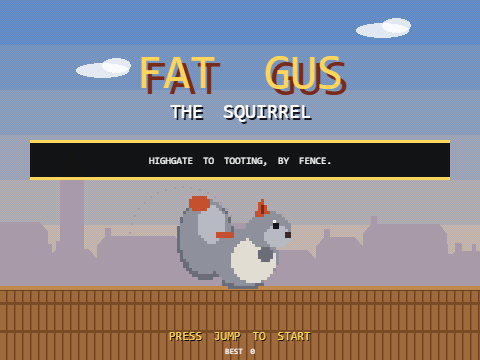
Fat Gus the Squirrel is ten levels of garden fences, shed roofs and treetops between Highgate and Tooting. The levels are the same every time you play, and so is the way every troublemaker behaves, so the game rewards learning it. This guide works through the numbers in the game: how far Gus can jump, what each animal and neighbour does and when, what is waiting on every level, and where the big points are.
HOW TO PLAY
Run to the street sign at the end of each level. On the last level, Joey is waiting instead.
- Keyboard: the arrows or A and D run left and right. Space, Up, W or Z jumps. P pauses and M turns the music off and on.
- Phone or tablet: the left and right arrows and the JUMP button under the screen do the same. Tap the screen to start and to move on between screens.
If you switch tabs or apps in the middle of a level, the game pauses itself. Press jump or tap to carry on.
HOW FAR GUS CAN JUMP
Gus gets to full running speed almost at once, so you don’t need a long run-up. What matters is how long you hold jump.
- Hold it for a full jump. That’s about five times his own height, and at a run it carries him more than five of his own widths along.
- Tap it for a hop. A hop is only about a sixth as high as a full jump, which is enough to skip over a mouse but not much else.
- You can steer in the air. Let go of the direction to drop short, or turn round to come back to a ledge you’ve overshot.
- There’s a little grace at the edges. You can still jump for a split second after running off the end of a platform, and a jump pressed just before you land still counts when you touch down.
A jump up onto something higher doesn’t go as far. At the tallest step the levels ever ask of him, a full jump carries Gus about three-quarters as far as one on the flat.
Fences, walls, sheds and roofs are solid, so if you run into the side of one you’ll stop dead. Jump on top of them. Tree branches are different. You can jump up through them from below and land on them from above.
TROUBLEMAKERS
Every troublemaker stays on its own fence, roof or lawn and never leaves it. If one is giving you trouble, getting off its patch is an escape. The one exception is a neighbour’s pellet, which flies a long way.
You can knock out any of them by landing on top of them, and that’s worth 100 points. Gus bounces off. Hold jump as you land and he bounces much higher, which is how to land on a second one straight after the first. All of them get faster as you go, and by Tooting they are about a third quicker than in Highgate.
| Troublemaker | First seen | Where | What it does |
|---|---|---|---|
| Cat | Highgate | Fences, walls, sheds, roofs and lawns | Strolls up and down. Stand near it and it crouches, hisses and pounces. |
| Mouse | Highgate | Fences, sheds and narrow ledges | Tiny and quick. The easiest one to land on, if you can time it. |
| Rat | Hampstead Heath | Walls, sheds and roofs | Like a mouse but bigger and a bit slower. |
| Dog | Camden Town | Lawns | Runs at you as soon as you’re close and on its level. |
| Angry neighbour | Regent’s Park | Wide, open lawns | Shouts “OI!” and fires an air rifle. |
Cats
A cat only pounces at a Gus who is standing on the same level and close to it. It crouches down and shivers for about a third of a second first, with a hiss, and that’s your moment to jump. It never pounces up at a Gus who is in the air, so dropping onto a cat from above is always safe. Jump just before you reach it rather than walking up to it.
Dogs
A dog that sees you runs straight at you. On the early levels a dog is a little slower than Gus, so you can outrun one. From Hyde Park onwards, a running dog is as fast as Gus or faster, so don’t try. Turn and jump on it, or jump to the next platform where it can’t follow.
Angry neighbours
The neighbours are the ones to respect. A neighbour turns to face you as you come near and stands his ground once you’re close. He only fires while you’re in range, and he always shouts “OI!” half a second before every shot. When you see it, jump.
- The pellet flies low, at about Gus’s knee height, so a full jump clears it easily. A quick hop only just gets over it, so don’t rely on one.
- Pellets fly straight through fences and walls, so a fence between you won’t save you.
- He reloads more quickly on later levels: about every two and a quarter seconds at Regent’s Park, and every one and three-quarter seconds by Tooting.
- He can’t shoot you when you’re right up close. The safest way past is to jump the pellet, run straight in, and land on his head before the next one.
A pellet costs a life, the same as being caught.
WALNUTS
A walnut is worth 50 points, but that isn’t why you want it. For ten seconds Gus glows gold, runs about half as fast again, and knocks out anything he touches, from any side. Pellets can’t hurt him either, and the music speeds up to remind you. There’s a bar at the top right of the screen that shows how long is left, and Gus starts to flash when there are two seconds to go.
Each level has a walnut a little before halfway, and from Regent’s Park there’s a second one about three-quarters of the way along. Since the walnuts never move, you can plan for them. The best use of one is to run straight through a stretch with several troublemakers on it, knocking out every one for 100 points each.
LIVES
Gus starts with 3 lives. Being caught, shot, or falling into a gap costs one and sends you back to the start of the level, and everything you scored on that go is lost, the nuts and the knockouts too. All the troublemakers come back.
Every level you clear gives you an extra life, and there’s no limit to how many you can have. That’s a big help, because if you get through Highgate and Hampstead Heath without a slip, you reach Camden Town with five lives.
THE TEN LEVELS
The table counts what is on each level. The widest gap is measured against a full running jump on the flat, so 87% means you have very little room to spare.
| Level | Nuts | Walnuts | Troublemakers | Widest gap |
|---|---|---|---|---|
| 1. Highgate | 44 | 1 | 4 cats, 1 mouse | 63% |
| 2. Hampstead Heath | 41 | 1 | 3 cats, 1 rat | 60% |
| 3. Camden Town | 82 | 1 | 3 cats, 2 mice, 1 rat | 57% |
| 4. Regent’s Park | 80 | 2 | 1 cat, 3 mice, 1 rat, 1 dog, 2 neighbours | 55% |
| 5. Marylebone | 88 | 2 | 6 cats, 3 mice, 1 rat, 4 dogs | 66% |
| 6. Hyde Park | 104 | 2 | 3 cats, 2 mice, 2 dogs, 2 neighbours | 60% |
| 7. Westminster | 101 | 2 | 9 cats, 2 mice, 3 rats, 2 dogs | 76% |
| 8. Vauxhall | 133 | 2 | 5 cats, 3 mice, 3 rats, 4 dogs, 1 neighbour | 72% |
| 9. Clapham Common | 127 | 2 | 5 cats, 9 mice, 1 rat, 2 dogs, 1 neighbour | 84% |
| 10. Tooting | 132 | 2 | 3 cats, 8 mice, 2 rats, 4 dogs, 1 neighbour | 87% |
Tooting is almost twice as long as Highgate. A few things worth knowing about the route:
- Highgate and Hampstead Heath are the place to learn the jump. The gaps are kind, and the Heath has lots of trees to practise on.
- Camden Town is the first level that’s mostly fences and rooftops, and it has twice as many nuts as the first two. This is where the score starts to build.
- Regent’s Park brings in the first dog and the first two neighbours, and the second walnut.
- Marylebone has no neighbours at all, but four dogs and six cats, and hardly any open lawn.
- Hyde Park is where dogs get faster than Gus. Two neighbours are waiting on the open lawns.
- Westminster has nine cats and no neighbours. Most of it is walls and rooftops, so watch for cats crouching on the walls.
- Clapham Common is full of trees, sheds and fences, with nine mice scurrying about. The gaps here are close to as wide as Gus can jump, so take a full run-up and hold the button all the way.
- Tooting has the widest gap in the game and the most dogs. Joey is at the end of it.
The parks, Hampstead Heath, Regent’s Park, Hyde Park and Clapham Common, have more lawns and trees. The town levels in between have more rooftops and fences.
SCORING
| What | Points |
|---|---|
| A hazelnut | 10 |
| A walnut | 50 |
| Landing on a troublemaker | 100 |
| Clearing a level | 500 |
| Each life left when you reach Joey | 500 |
Add up everything on all ten levels and there are about 26,500 points to be had on the way. Every life you finish with is another 500 on top. If you never lose one, you reach Joey with thirteen lives, the three you started with and one for every level, which is another 6,500. So a perfect run would score just over 33,000.
That’s why losing a life hurts twice. You lose what you’d scored on that go at the level, and you lose 500 at the end. A life is worth 50 nuts.
Your best score is saved in your browser and shown on the title screen.
TIPS
- Don’t walk up to a cat. Jump before you get close, and land on it if you can.
- Hold jump when you land on something. The higher bounce gives you time to look for the next one.
- Watch for “OI!” You get half a second, which is plenty if you’re looking for it.
- Save the walnut for the crowd. If you know a busy stretch is coming, don’t rush to the walnut early and waste the ten seconds on empty fences.
- Use the nuts as a guide. An arc of nuts over a gap shows where a good jump goes.
- Take the wide gaps flat out. On the last few levels, a jump from a standing start or a tapped jump won’t make it. Run at it and hold the button until you land.
- When it all goes wrong, get off the patch. No troublemaker ever follows you to the next platform, though a neighbour can still shoot across to it.
IF YOU LIKE THIS
Mega Menagerie is more animals behaving badly, and its animal guide explains which monster to pick. For another high-score chase, try Fart Attack, with its high-score guide.
The controls, the story so far and how the game was made are on the Fat Gus the Squirrel page.