
Meadow Fever team guide: the best Shrewsbury eleven for the cup run
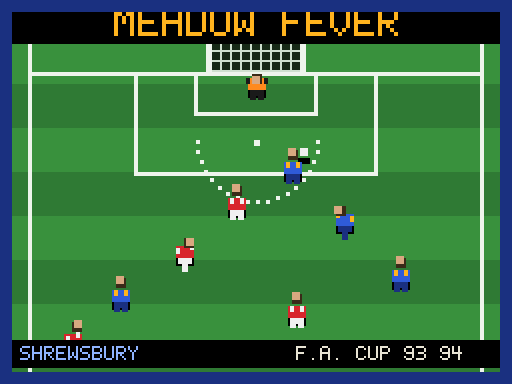
Meadow Fever lets you pick a new eleven before every tie, and there are no substitutes, so the team sheet matters more than it looks. This guide lists every player’s ratings, suggests the strongest side, and shows how much stronger each round’s opponents get.
The ratings are invented for the game. Nobody published attribute scores for the Third Division in 1993. They’re what the game uses, though, so they’re what this guide uses.
WHAT THE RATINGS DO
Each player has five ratings out of 100, and keepers have a sixth:
- Pace (PAC) wins the race to a loose ball, which is most of tackling in this game.
- Control (CTL) decides how well the ball comes round with a player when he turns.
- Power (PWR) decides how hard and far a full-strength kick goes.
- Accuracy (ACC) decides how close the ball goes to where you aimed it.
- Tackling (TKL) decides how often a challenge wins the ball, and how often it’s reckless enough to earn a booking.
- Goalkeeping (GK) is for keepers only.
THE SQUAD
| Player | Pos | PAC | CTL | PWR | ACC | TKL | GK |
|---|---|---|---|---|---|---|---|
| Paul Edwards | GK | 52 | 55 | 72 | 58 | 40 | 72 |
| Tim Clarke | GK | 54 | 52 | 68 | 55 | 38 | 64 |
| Dave Hockaday | RB | 62 | 60 | 64 | 62 | 72 | |
| Kevin Seabury | RB | 68 | 58 | 58 | 56 | 68 | |
| Dave Walton | CB | 56 | 52 | 74 | 54 | 78 | |
| Mark Blake | CB | 52 | 54 | 68 | 56 | 76 | |
| Mark Williams | CB | 55 | 53 | 70 | 54 | 77 | |
| John Brough | CB | 54 | 51 | 66 | 52 | 73 | |
| Chris Withe | LB | 60 | 56 | 62 | 56 | 70 | |
| Tommy Lynch | LB | 60 | 62 | 62 | 60 | 69 | |
| Steve MacKenzie | CM | 50 | 78 | 78 | 78 | 56 | |
| Kevin Summerfield | CM | 56 | 72 | 68 | 74 | 58 | |
| Mark Taylor | CM | 60 | 68 | 64 | 68 | 64 | |
| Paul Evans | CM | 64 | 66 | 74 | 66 | 62 | |
| Gary Patterson | CM | 58 | 58 | 66 | 58 | 76 | |
| Ray Woods | CM | 60 | 62 | 62 | 62 | 60 | |
| Louie Donowa | RM | 80 | 68 | 60 | 64 | 42 | |
| Brian Croft | RM | 70 | 64 | 58 | 62 | 48 | |
| Mark Rutherford | LM | 68 | 62 | 58 | 60 | 50 | |
| Mark Smith | LM | 66 | 60 | 58 | 58 | 46 | |
| Wayne Clarke | ST | 54 | 70 | 74 | 80 | 40 | |
| Mickey Brown | ST | 76 | 66 | 60 | 64 | 44 | |
| Joe Gallen | ST | 64 | 62 | 66 | 62 | 46 |
THE STRONGEST ELEVEN
The game plays a 4-4-2. This is the side the ratings favour:
| Slot | Player | Why |
|---|---|---|
| GK | Paul Edwards | 72 goalkeeping, against Clarke’s 64 |
| RB | Dave Hockaday | The best tackler among the full backs |
| CB | Dave Walton | 78 tackling, the best in the squad |
| CB | Mark Williams | 77 tackling |
| LB | Tommy Lynch | Better on the ball than Withe for almost no defensive cost |
| RM | Louie Donowa | 80 pace, the fastest player at the club |
| CM | Steve MacKenzie | 78 control, power and accuracy |
| CM | Kevin Summerfield | 72 control and 74 accuracy |
| LM | Mark Rutherford | The quickest left-sided player |
| ST | Wayne Clarke | 80 accuracy, the best finisher |
| ST | Mickey Brown | 76 pace, to run beyond Clarke |
Clarke and Brown make a good pair because they’re opposites. Clarke is slow but accurate, so feed him to feet near the box. Brown is quick but a weaker finisher, so play balls over the top for him to chase.
SUSPENSIONS AND THE BENCH
A sending-off means ten men for the rest of the match, and the player misses the next round too. Have a replacement in mind for every slot:
- Centre back: Mark Blake (76 tackling) is almost as good as either starter.
- Full back: Kevin Seabury on the right, Chris Withe on the left.
- Centre midfield: Paul Evans has the most pace and power of the reserves. Gary Patterson is the one to pick if you need a ball-winner.
- Wide: Brian Croft on the right, Mark Smith on the left.
- Up front: Joe Gallen.
How cards work:
- Most fouls are just a free kick. A foul is a slide that reaches the man instead of the ball.
- A yellow is more likely the worse the tackler and the faster he’s going. Your centre backs, with tackling in the high 70s, are the safest players to slide with. A winger or striker sliding in at full pace is the most likely to be booked. Two yellows make a red.
- A straight red is for denying a goal. If you foul a man who has the ball, is heading for goal, and has nobody left to beat but the keeper, he goes off. When an attacker is clean through, let the keeper deal with it.
PLAYING OUT OF POSITION
You can put anyone anywhere, but a player out of position loses part of every rating:
| Where you put him | Ratings kept |
|---|---|
| His own position | 100% |
| A neighbouring position (a right back at centre back, a winger up front) | 94% |
| Anywhere else outfield | 86% |
| A keeper outfield, or an outfield player in goal | 70% |
A neighbouring position barely matters. Paul Evans in the right-midfield slot, for example, keeps 94% of everything, which still leaves him with more power than Donowa.
THE OPPOSITION
Each opponent is built around one strength number, with a spread across the side so that even the best teams have a weaker player somewhere. Their two strikers get an extra 6 points, so the danger is always up front. For comparison, the strongest Shrewsbury eleven above averages in the low-to-mid 60s across its ratings.
| Round | Opponents | Strength |
|---|---|---|
| First round | Telford United | 40 |
| Second round | Rochdale | 46 |
| Third round | Barnsley | 52 |
| Fourth round | Sheffield Wednesday | 58 |
| Fifth round | Aston Villa | 62 |
| Quarter-final | Blackburn Rovers | 65 |
| Semi-final | Arsenal | 68 |
| Final | Manchester United | 72 |
The first three ties are against weaker sides on paper. From Aston Villa on, you’re the underdog, and the final is a genuine upset if you win it. Against the big sides, play for chances rather than possession: win the ball, get it to Donowa or over the top to Brown, and shoot early.
The controls, the story so far and how the game was made are on the Meadow Fever page.