
Fairground Days ticket guide: every stall, every bear and how to score 100
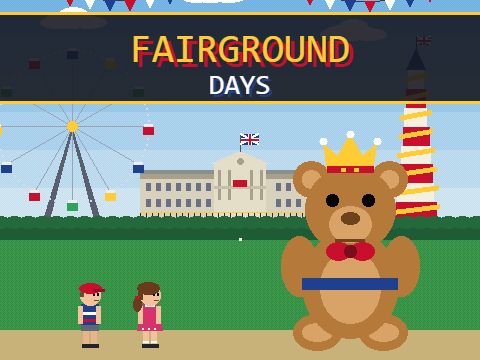
Fairground Days is five stalls and a prize counter. Each stall pays up to 20 tickets, so the best possible day is 100, and the biggest bear costs 88. That leaves you 12 tickets to drop across the whole fair. This guide goes through what every stall is really paying for, and the timings that get you there.
HOW TO PLAY
Choose a boy or a girl, then play the five stalls in order: Coconut Shy, Shooting Gallery, Bean Bag Toss, Hook-a-Duck and Whack-a-Mole. Everything is played with one pointer.
- Mouse: move to aim, hold the button for power, and let go to throw or fire. At the moles, just click.
- Touch: touch to aim, hold for power, and let go. At the moles, just tap.
- M turns the music on and off.
On a phone, the crosshair at the Shooting Gallery sits a little above your finger, so your finger doesn’t hide what you’re aiming at. Hook-a-Duck works differently by touch: see its section below.
THE PRIZES
Your total buys the best bear it reaches. Nobody goes home empty-handed.
| Tickets | Bear | Average needed per stall |
|---|---|---|
| 0 | Pip the Palm Bear | Nothing at all |
| 30 | The Little Earl | 6 |
| 50 | Bertie the Bear | 10 |
| 70 | The Grand Old Duke | 14 |
| 88 | His Royal Hugeness | 17.6 |
The prize counter tells you how many more tickets you needed for the next bear up, which is a good guide to which stall to practise.
1. COCONUT SHY
Ten balls and six coconuts: three small ones on the back row and three bigger ones on the front. Each coconut is worth 3 tickets, so all six is 18. Clear the lot with balls to spare and you get a bonus of up to 2 more, one for each ball left over. To score the full 20 you need to clear the shy in eight balls or fewer.
Holding raises the crosshair, and it speeds up as it climbs. So the timing is everything:
- Front row: let go just before a second.
- Back row: let go a little after a second, and before the power bar fills. Hold too long and the ball sails over the top.
The back-row coconuts are smaller and the crosshair is moving faster when it reaches them, so you get noticeably less time to catch them than on the front row. Take the front row first while you’re warming up.
A clean hit knocks a coconut straight off. A ball that only clips the edge makes it wobble, and once it has wobbled, any hit at all, even another glancing one, knocks it off. A wobbling coconut is the easiest target on the stall.
2. SHOOTING GALLERY
Twelve corks, forty seconds, and three rails of targets. The top rail runs slowest to the right, the middle runs left, and the bottom rail is the fastest.
| Target | Tickets | How often it comes round |
|---|---|---|
| Crown | 3 | About 1 in 12 |
| Roast beef, Yorkshire pudding, spotted dick | 2 | About 5 in 12 |
| Fish and chips, toffee apple | 1 | About 4 in 12 |
| The King’s corgi | -3 | About 1 in 6 |
Twelve corks at 2 tickets each is 24, so you can reach 20 without hitting a single crown. What you can’t afford is spending corks on the 1-ticket targets. Skip the fish and chips and the toffee apples, and save your corks for the 2s and the crowns.
Your aim sways until you hold. It steadies the longer you hold, and is about as still as it gets after 0.8 seconds. Let go before then and the cork goes wherever the sway was taking it. After each shot there is a short reload, about a third of a second, before you can fire again.
Shooting a corgi costs you 3. Your score can’t go below nothing, but the corgi can wipe out a crown.
3. BEAN BAG TOSS
Eight bags and a board painted as a menu, with four holes in it:
| Hole | Tickets |
|---|---|
| The small one at the top | 3 |
| The two in the middle | 2 each |
| The big one at the bottom | 1 |
Eight bags in the top hole would be 24, so 20 needs about four in the top and four in the middle. The bottom hole is there for when a run has gone wrong.
As at the coconut shy, holding raises the crosshair and it speeds up as it climbs. So the further the hole, the less time the crosshair spends on it: you get roughly an eighth of a second to let go for the bottom hole, and only about a twenty-fifth of a second for the top one. As a rough guide, let go at about three-quarters of a second for the bottom hole, just under a second for the middle two, and a little over a second for the top.
The crosshair shows where the bag lands, but a bag slides on up the board after it lands, and a harder throw slides further. A bag thrown at the top hole slides on about the width of the hole itself. So aim just short of the hole, at its bottom edge or a little below, and let the slide carry it in. Practise on the middle holes first, where the slide is shorter, the holes are bigger and the crosshair is still moving slowly enough to catch.
4. HOOK-A-DUCK
Sixty seconds, and the stall closes as soon as you reach 20 tickets. Six ducks swim round the outer ring and three round the inner ring, going the other way. A plain duck is worth 1 ticket. A gold duck is worth 3.
The hook takes a quarter of a second to reach the water, and when it lands it catches any ring close enough to it. How you get it there depends on what you’re playing with.
With a mouse, you steer the rod. It doesn’t jump to the pointer: it swings after it, at about a screen’s width a second, so give it a moment to arrive before you drop. Hold to drop the hook, and let go to reel in. If you let go before it reaches the water, it comes back up without trying. After every catch, the rod goes back to the top of the pond, so the quickest next duck is usually one near the top.
By touch, there’s no rod to steer. Tap the water just ahead of a duck, and the hook drops right where you tapped. It then waits in the water for about a fifth of a second, catching any ring that swims into it, and comes back up by itself. So the skill is timing: tap where the ring is going to be, a moment before it gets there.
- Lead the ducks. In a quarter of a second, an outer duck travels about one and a half times the width of its ring. Aim ahead of it, in the direction it’s swimming.
- The inner ducks are slower. If you keep missing on the outer ring, fish the middle.
- Let go fast after a miss. With a mouse, the hook stays in the water until you let go, and then takes a moment to come back up.
- Gold ducks come later. None of the first nine ducks are gold. After a duck is hooked it comes back about a second and a half later, and roughly one time in eight it comes back gold. Go for every gold duck you see.
Sixty seconds is enough for 20 tickets, but only if you don’t waste drops.
5. WHACK-A-MOLE
Forty seconds and nine holes on the Royal Lawn. A whack counts the moment you press, and it doesn’t have to be dead on: anywhere near the hole will do. Missing costs you nothing.
| What pops up | Points | How often |
|---|---|---|
| Mole | 1 | 6 in 10 |
| Guardsman in a bearskin | 2 | 2 in 10 |
| Crowned mole | 3 | 1 in 10 |
| Corgi | -2 | 1 in 10 |
Every 3 points makes a ticket, so 20 tickets needs 60 points. That is most of what comes up in forty seconds, so this stall is about keeping up rather than picking and choosing. The moles come quicker, and stay up for less time, as the clock runs down: at the start one pops up nearly every second and stays up for a second, and by the end it’s closer to two every second, with each gone in under two-thirds of a second.
Whack everything except the corgi. A corgi only costs 2, so if your hand is already on its way, it’s not worth losing the next mole to pull back.
THE SCOREBOARDS
Your score is your total tickets, out of 100. There are two shared top-twenty boards, one for mobile and one for desktop. If you touch the screen at any point in a run, it goes on the mobile board. Played all the way through with a mouse, it goes on the desktop board.
IF YOU LIKE THIS
Roll-a-Ball Derby is the seaside cousin of Fairground Days: ten races at ten British resorts, rolling a ball up a sloping table for points. Mega Menagerie is another one-tap arcade game that plays just as well on a phone, with seven giant animals and ten cities to knock down.
The controls, the story so far and how the game was made are on the Fairground Days page.